Audit layer: why coding agents need evidence
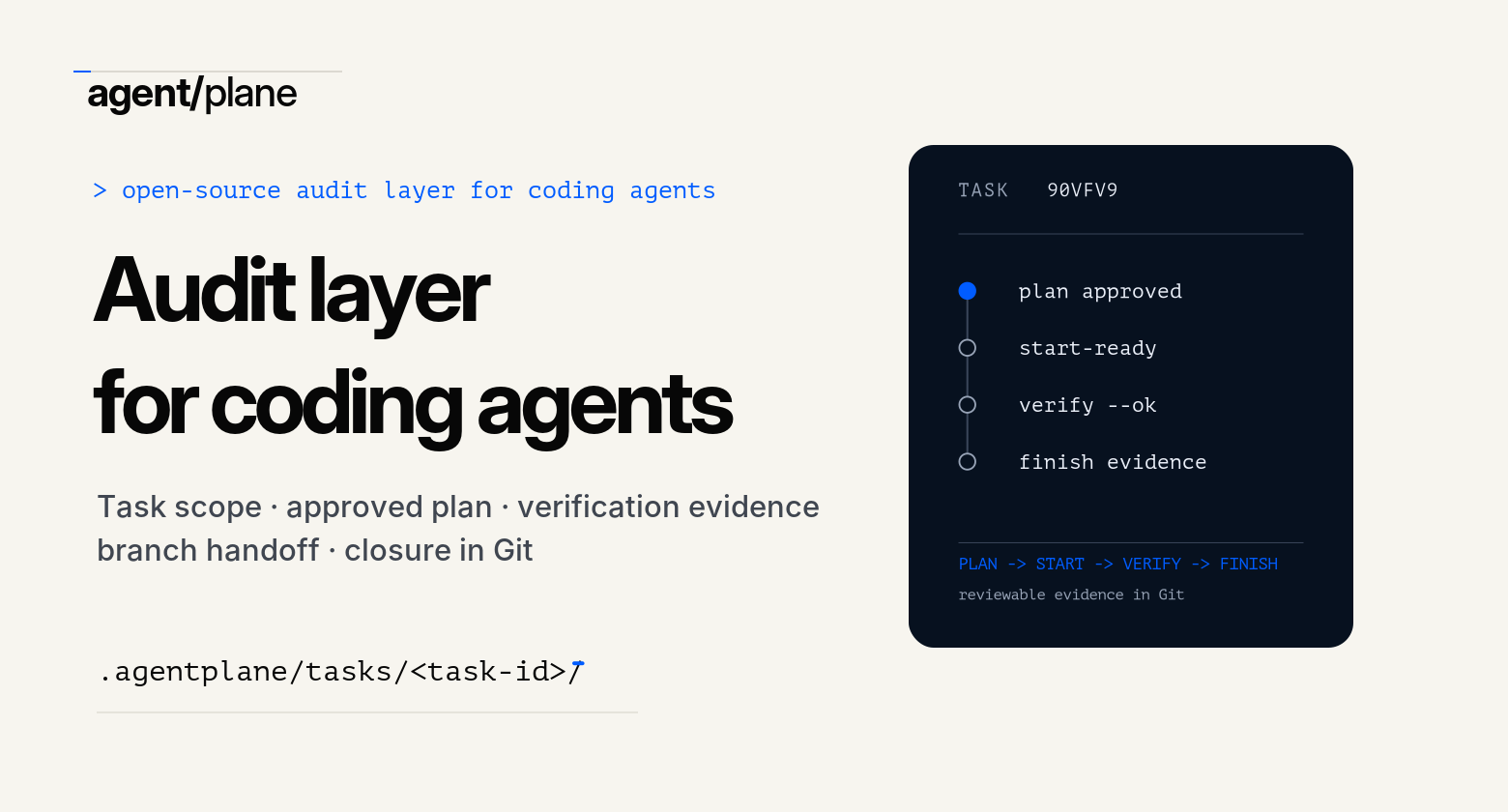
Coding agents are already good enough to change real repositories.
The weak part is not always the code they write. The weak part is the trail around the code: why the task existed, which plan constrained it, who owned the execution, which checks ran, and what made the work safe to close.
That is the product boundary Agentplane is built around. It is not another coding agent. It is the audit layer around coding-agent work.
The diff is too small a record
A pull request can show the final files. It usually cannot show the agent's full operating context.
That context matters when work is bigger than a one-line edit:
- a task needs a durable ID,
- a plan needs approval before mutation,
- an agent needs role-specific constraints,
- verification needs evidence,
- integration needs a clear handoff,
- closure needs to say what actually passed.
Without that trail, reviewers end up reconstructing intent from a diff, a branch name, and whatever still exists in a chat window.
Agentplane makes the trail a repository artifact.
What changed in 0.4
The 0.4 line moved Agentplane toward a more explicit recipe and prompt-module system.
The important part is not the internal architecture by itself. The important part is what it enables: narrow behavior modules that can be inspected, validated, and composed without replacing an entire instruction surface.
That matters for recipes because useful recipes should be specific.
A recipe should be able to add a code-map workflow, constrain a role, bind a policy module, or validate a prompt graph without asking the project to trust an opaque blob of instructions.
Recipes are audit behavior
Recipes are easy to describe as automation. That is incomplete.
In Agentplane, a useful recipe is repeatable audit behavior:
- it declares what behavior it adds,
- it can be installed into a repository,
- it can be checked against local policy,
- it can produce reviewable task artifacts,
- it can stay inside the same Git-based lifecycle as normal work.
That is different from a script pile. The recipe is not only "run these commands." It is "add this repeatable behavior to the agent workflow and keep it inspectable."
Why this belongs in the repository
Agent workflows become harder to trust when the durable record lives outside the repo.
Agentplane keeps the important parts close to the code:
AGENTS.mdis the policy gateway,.agentplane/policy/holds canonical rules,.agentplane/tasks/<task-id>/records task state and evidence,- branch and pull request artifacts connect work to Git review,
- generated references and discovery files help humans and agents find the right path.
The repository remains the source of truth. Hosted tools can still help, but the audit record does not depend on them.
Where this fits with coding agents
Claude Code, Codex, Cursor, and Aider are execution surfaces. They help generate, edit, and explain code.
Agentplane gives those agents an operating contract:
- load the right policy,
- create or use a task,
- approve the plan,
- execute inside scope,
- record verification,
- hand off integration cleanly.
That contract is intentionally boring. Boring is useful when an agent can mutate a repository.
What to read next
Start with the short product framing:
The practical test is simple: after the agent finishes, can another human or agent understand why the change happened and why it was closed?
If the answer is no, the workflow is missing an audit layer.